Em dezembro os coquinhos começam a aparecer na Areca Bambú. Eles crescem tanto, e tão rápido, que os passaros começam a comer os pequenos.
Você pode ver muitos galhos deles no Areca Bambú em toda a cidade. Lá tem nove galhos em nossa árvore.
No final de Fevereiro seis dos galhos foram arrancados. Mas esses três foram os maiores e os melhores.
Esses três galhos estão cheios de pequenos coquinhos agora.
Muitos passaros pequenos viram com a amostra de suco dessas sementes. Mas usualmente eles são muito timidos para esperar até que nós pegamos a camera para fotografa-los.
Você pode ver aqui muitos dos pequenos galhos que foram arrancados.
Mas agora olhem quantos sobraram.
Eu finalmente peguei umas fotos de um pequeno passaro olhando os pequenos coquinhos.
Ele ficou um tempinho checando todos os coquinhos.
Os coquinhos são de 1 a 1.5 centimetros. Portanto esse passaro e 5 ou 6 centimetros maior.
Agora o próximo passo é para os Papagaios verdes chegarem e se encherem de seu petisco preferido. Um dia vai ter um barulho muito grande quando eles chegarem para pegar os coquinhos.
Tradução - Henrique Ribeiro
Fotos de Urso Branco
Quarta-feira, 27 de Fevereiro de 2008
Palma Areca Bambú no Verão
Postado por
Urso Branco
às
13:49
0
comentários
Quarta-feira, 24 de Outubro de 2007
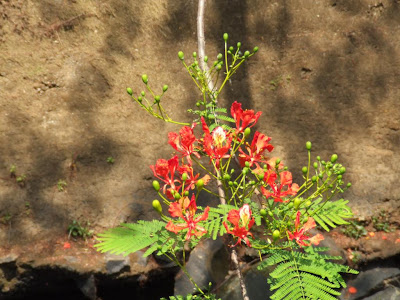
Flamboint no primavera

Este um coleção do Ávore Flamboint muito linda no primavera. Estes muito em Águas da Prata. Algumas estão começando florescer e as outras estão fazer uma demonstração muito flamboint, portanto o nome.
Scroll baixa e ver todos as árvores perto de nossa casa.


Fotos de Urso Branco
Postado por
Urso Branco
às
11:40
0
comentários
Quinta-feira, 4 de Outubro de 2007
Um Coleção Casual no Inverno

Although it is winter we have many tree and bushes in bloom in Águas da Prata. The colour makes the bitter cold winter bearable. The temperature often plummets down to +15. *SORRISO*
In winter they trim many trees back like this. It looks like the end for some.
They seem extreme in many cases but they come back in spring with the arrival of the rains
This large croton never fails to please. It is the largest croton I have ever seen.
Many trees have large seed pods like this.
This bush is across the stret from our house.
This beautiful tree grows in many places in Águas da Prata.
This is a large poinsettia over the wall beside our house.
This poinsettia is a very large tree near our house.
There are many pretty small tress around town like this. planted in the sidewalk.
These stately blue topped trees are all around town.
A telephoto lens helps when you peak into someones backyard to see beauty like this.
There are very many more Flowering Trees and Shrubs of all colours and sizes making Águas da Prata a beautiful town.
Fotos de Urso Branco
Postado por
Urso Branco
às
09:22
0
comentários
Quarta-feira, 3 de Outubro de 2007
Lindas Cores dos Hibiscus

Here is a beautiful selection of many colours of Hibiscus, all grown in one garden in Poços de Caldas.
Hibiscus, or rosemallow, is a large genus of about 200–220 species of flowering plants in the family Malvaceae, native to warm temperate, subtropical and tropical regions throughout the world. The genus includes both annual and perennial plants, and woody shrubs and small trees.
Each blossom here is different either in colour or petal shape or pistols and stamens.
Scientific classification
Kingdom: Plantae Division: Magnoliophyta Class: Magnoliopsida Order: Malvales Family: Malvaceae Genus: Hibiscus 


All these beauties were growing in this well maintained privatre garden.
Hibiscus is a favourite among artists. Here are four samples of wood carving by Ed Lucas of Águas da Prata. The first is a bed head. The others are rustic coat hangers.


As the seasons progress the Hibiscus trees in Águas da Prata will be in full bloom. We will show them as they mature.
Fotos de Urso Branco
Postado por
Urso Branco
às
17:42
1 comentários
Terça-feira, 18 de Setembro de 2007
Coroa de Cristo no Inverno

Euphorbia milii (Crown-of-thorns or Christ Plant) is a species of Euphorbia native to Madagascar.
It is a succulent climbing shrub growing to 1.8 m tall, with densely spiny stems, the straight, slender spines up to 3 cm long, which help it scramble over other plants. The leaves are obovate, up to 3.5 cm long and 1.5 cm broad. The flowers are small, subtended by a pair of conspicuous petal-like bracts, variably red, pink or white, up to 12 mm broad.
This little shrub is a popular house plant. Many varieties and hybrids are available varying in flower size and color from red to yellow. It blooms freely most of the year. It normally becomes dormant in summer… don't throw it away if it loses its leaves. As with the other Euphorbias, its sap is poisonous, it irritates the skin, and can cause temporary blindness if it goes in the eyes. Each spine contains enough sap to do real harm to those who get stuck on it.
In Brasil it is grown beside or on walls to deter unwanted visitors. So don't climb over the wall.
This group of plants is growing against the wall next door to out house in Águas da Prata.
Look closely at the abundance of thorns on the stem.
The flowers are tiny but pretty.
You can see the long row of plants leading towards our house.
Here they are leading away from our house.
Here is a garden on the next street using Crown-of-Thorns as a decorative hedge.
It looks quite pretty in this setting.
I found there is a lot of Crown-of-Thorns around town. Here is a large hedge about two city blocks long.
It gives new meaning to the phrase "Keep Out"!
This section is particularlyt lethal looking.
It looks pretty from a distance. This entire property uses it as a privacy and security fence.
Here it is as a security hedge on top of a wall. I wouldn't want to try to get in there.
So be careful and never try to touch these shrubs without adequate protection.
Fotos de Urso Branco
Postado por
Urso Branco
às
20:58
0
comentários
Arvore Flamboint no Inverno

This tree is exotic at any season in Águas da Prata. It's Botanical name is Delonix Regia.
The Royal Poinciana, Delonix regia (family Fabaceae), is a tropical or subtropical
flowering plant. It is also known by the names Gulmohar, Flamboyant Tree, Peacock Flower, Flame of the Forest, and Flame Tree. The tree is named after Phillipe de Longviliers de Poincy who is credited for introducing the plant to the Americas.
The Royal Poinciana has been described as the most colourful tree in the world. The tree's vivid red/vermilion/orange/yellow flowers and bright green foliage in any case make it an exceptionally striking sight.
It has gone to seed now and here are the large seed pods in profusion.
They are about 25cm long and very hard and dry now.
These large trees are in many places around town. These ones are near the Grande Hotel Prata.
They line the street beside the old railway station, across the street from the town Counsel Chambers.
They are large and something to be seen in summer.
This is a dried seed pod.
They fall all the time now in mid to late September.
You can see these pods everywhere around the trees.
When these trees are in bloom in summer the have hundreds of brilliant red - vermilion - orange or yellow flowers and bright green foliage. We will have many photos of them in bloom later.
Fotos de Urso Branco
Postado por
Urso Branco
às
20:23
0
comentários
Palma Areca Bambú no Inverno

This is a Butterfly Palm or Areca Bambú Palm, or Golden Cane Palm growing in our yard. Its botanical name is Dypsis lutescens and it originated in Madagascar
This is one of two lovely trees in our yard that have something extra to delight us besides their natural beauty at this time of year. I am including it here because we caught it just as it sprouted 4 seed stocks. These are photos of this Areca Bambú Palm in mid September in Águas da Prata.
It is a clustering palm, with up to about a dozen golden coloured trunks, but no main trunk. The trunks curve out from the base, while the feather leaves are quite recurved as well.
This is one of the most popular palms in the tropics and sub-tropics, due to its ease of growth, and attractiveness. Used for both landscaping duties, as well as an indoor plant. It is a very adaptable palm, but grows best in full sun, in a well drained, but moist spot. It is drought tolerant, but not very frost tolerant.
When the seed stock opens as it looks like this.


Close up.
Very close up you can see the individual nuts. The birds love them. As soon as they mature we will have flocks of birds come to dine. They only take a day to eat all these nuts.
As you can see each little branch is loaded with nuts.
Here is a second stock not opened yet.
Here is the second stock from a different angle.
This is a third stock.
You can see a fourth stock just starting to grow.
This photo lets you see all four stocks.
Last year we only had one stock. So this year we expect to see a great parade of birds visiting us. It should be exciting to watch. However, we must keep the cats away while the birds feed. There are no stocks showing up in the other tree yet. The nuts are a favourite food for the Green Parrots.
This is another tree a few blocks awy from our house. It has very many seed stocks.
The tree has most of its stocks already open.
This will be a favourite spot for the parrots to visit soon.
References:
Palm & Cycad Societies of Australia
http://www.pacsoa.org.au/palms/Dypsis/lutescens.html
K-Palms Nursery and Seeds
http://www.kpalms.com/
Fotos de Urso Branco
Postado por
Urso Branco
às
17:34
0
comentários
Quinta-feira, 6 de Setembro de 2007
Hibiscus no Inverno

You can find Hibiscus everywhere in Brasil. This is on our street in Águas da Prata. Hibiscus is a very popular and prolific flower. It is a favourite of artists and woodcarvers.
Hibiscus comes in Tree form and Bush form. These are just a few of them blooming in Winter.
There are few blossoms and leaves are thinning out too. These two photos were taken at Restaurante Arvorismo.
They are right at the Parking lot.
We have many colours of Hibiscus in Brasil.
Fotos de Urso Branco
Postado por
Urso Branco
às
17:50
0
comentários
Mão de Vaca no Inverno

This tree is called Cowhand because of the shape of the leaves. They are shaped like the hoof print of cows.
They are in various stages of bloom in Águas da Prata. Some have the last of the blossoms from last year and look very scraggly. Others have full fresh leaves, ready for Spring. This is caused by Global Warming.
This is a Cowhand with violet and white blossoms.
This Cowhand has white blossoms.
This Cowhand has a few white flowers left and many seed pods like beans.
This Cowhand has violet and white blossoms.
This Cowhand has all new leaves, ready for Spring.
Here is a closeup view of the leaves.
Here are two more Cowhands with white blossoms.
As winter ends so do the blossoms.
Now the Cow Hand is full of seed pods.
The variations in colour make these very interesting trees. There are many Cowhand trees in Águas da Prata.
Photos by Urso Branco
Fotos de Urso Branco
Postado por
Urso Branco
às
17:44
0
comentários
Primavera no Inverno

Primavera (Portuguese for Spring) usually blooms in Spring. However Global warming has all the Flowering Trees and Shrubs confused with the seasons. Spring is only a couple weeks away and the question is, "Will Primavera Flourish in Spring?"
Águas da Prata is a great place for flowers and Primavera tends to bloom most if not all of the year. These photos show how beautiful Primavera is in Águas da Prata this winter.
Primavera grow over many walls and fences in Águas da Prata.
It is very beautiful in red.
This cluster of blooms hangs over the wall next to our house.
Here is a lovely White Primavera hanging over a fence close to our house.
As we get closer we see how dense the remaining blossom clusters are.
This is a close up showing them at their full beauty.
Next door to us this bush is growing high over the wall.
This is a small bush growing a couple blocks away in a sidewalk.
More Primavera.
These are a mixing of Pink and Red Primavera. It makes a lovely showing.
These Primavera planted on the sidewalk are darker red, almost purple.
But on a bright sunny day, up close, they appear more Pink.
Primavera is all over town even hanging over the garages.
Primavera is easy to cultivate and grows prolifically. The climate here certainly favours them. When Spring arrives we will show them renewed in a new post.
Fotos de Urso Branco
Postado por
Urso Branco
às
11:37
0
comentários
Mayflower no Inverno

These trees are called May Flower because they bloom in May. Two years ago we noticed something happening to the trees in Águas da Prata and São João da Boa Vista. They were dropping their blooms before they opened.
They have unique blooms. They are large balls as big as extra large grapefruit. They did not bloom in May this year as they were supposed to.
These photos are of the trees in São João da Boa Vista because they are easier to photograph.
These photos were taken in July, two months after they were supposed to bloom.
These photos show just how many balls there are in these trees.
You have to look twice to be certain they are blossom buds, not fruit.
Since they are late with the balls, maybe they will bloom in September.
If they do bloom they will be very large white blossoms. They are quite beautiful.
It is believed they are late blooming because of the effects of Global Warming. Last year (2006) all the balls fell before they opened, both here in Águas da Prata and these trees shown here in São João da Boa Vista. If they do open this month (September) I will include the blossom photos here too.
Fotos de Urso Branco
Postado por
Urso Branco
às
11:35
0
comentários
Ipe no Inverno

Ipe is the National Tree of Brasil. It is that yellow flowering tree next door to our house.
It is a very hard wood and was used for furniture making in the old days because of its durability. It is now a protected species and it is illegal to even cut a tree down now.
We will show the development of the Ipe Trees through the seasons. For now we show what they look like in Winter.
There are very many Ipe Trees in Águas da Prata. This is a yound one near our house.
This is an older tree full of blossoms. Notice the leaves were dropped in Autumn but the flowers flourish right into late winter. 
The blooms are a very distinctive yellow about 4cm across.
Here is a very tall Ipe on the street. Notice the blossoms are at the ends of the branches.
The streets get covered in a blanket of gold when the blossoms drop.
When the blossoms are gone you see long seed pods.
This seed pod is about 20cm long. Note the last bloom hanging on. This is late in August.
Some trees are loaded with seed pods all twisted and turned in interesting shapes..
This same tree had hundreds of seed pods.
When they finally mature they split open revealing hundreds of seeds with parachute silk to disperse them in the winds of late August.
This is what the seed pod looks like when it gets its fuzzy brown coat. It comes off when you touch it.
This young Ipe has with three stages in it. It still has blooms. The seedpods have the brown fuzz and some seed pods are already open.
This little Ipe is just across the street form the one above.
This is just around the corner from our house. Notice these trees are still blooming while others have already dropped the seeds. We noticed that in nearby São João da Boa Vista there are Ipe Trees still loaded with yellow blossoms.
Even in the first week in September you can see some Ipe still in bloom in the center of town in the Praça da Bandeira.
This Ipe is still in full bloom behind the Restaurante Prata.
You can see the Ipe trees better in this View of the Praça da Bandeira. They are still loaded with blossoms.
In this view you can see different stages of the Ipe trees, from full of blossoms to almost none.
It has been suggested that Global Warming has these trees very confused in Brasil. So they are out of phase with the normal seasons.
Unlike in Canada where all the trees turn around the same time, here in Brasil it is an ongoing process from Autumn to the end of winter. Spring is just around the corner and the process will start again.
Fotos de Urso Branco
Postado por
Urso Branco
às
11:34
0
comentários

